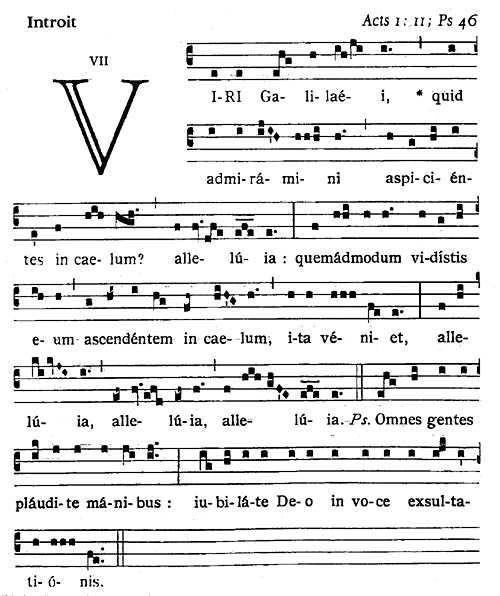
Ye men of Galilee, why are you gazing in astonishment at the sky? Alleluia. Just as you have seen him ascend into heaven, so, in like manner, shall he return, alleluia, alleluia, alleluia. All nations, clap your hands; shout unto God with a voice of joy.
Johner writes as follows:
When we met the Saviour at Christmas, we greeted Him with the seventh mode. The motive dc ed dd over the accented syllable of Galilaei reminds us also of nobis in the Introit for the third Christmas Mass. Now the seventh mode leads the Lord back to the Father, who today will speak that long-promised word: “Now sit Thou at My right hand.”
On Bethlehem’s fields once the angels sang; today we again hear angels. They seem to have a special preference for the seventh mode in plainsong. Their words are addressed to the Apostles, who find it impossible to turn their eyes away from heaven, whither their dearest Lord and Master has ascended. And here the angels do not say, as the Acts of the Apostles report: “Why stand you looking up to heaven?” but: Quid admiramini aspicientes-—”Why wonder you, looking up to heaven?”
This word also supplies the key to the understanding of this Introit. The Apostles may not stand still and rest. Now is the time of labor, of strife, of suffering. Now they must fulfill the commission with which the Lord charged them. Now they must sow the seed in tears, in sweat, and in sorrow. Not till later will the time come for repose, for blissful contemplation of God. Perhaps the angel wished to stress another thought: “It is difficult for you to realize that your dearest Lord has departed from you. You cannot but wonder, and it is wonder that tends to make you sad. But be comforted! He will come again; you will see Him; and never again lose sight of Him. Just as true and real as His ascension is today, will His return be with power and majesty.” This consoling thought, finds expression in the jubilant cries of alleluia. And St. Luke tells us (24: 52) that the disciples returned to Jerusalem “with great joy.”
Today we also exult and rejoice, because the work which the Father gave His Son to do is now perfected. His glorification is ours also. He has, in the words of today’s Communicantes, set at the right hand of the Father’s glory the substance of our frail human nature which He had taken to Himself, and He says to the Father: “Father, I will that where I am, they also may be whom Thou hast given me.”
The melody calls for an easy and joyous rendition… In the rendition, this climacus, and all the alleluia in fact, demand a most hearty rendition. Our joy should be voiced wholeheartedly. The rhythmic motive over admirdmini, dedc c (4 plus 1), runs through the entire piece, recurring over aspici-(entes), vidistis e-(um), (ascenden)- tern in cae—and over the second caelum. After the accented syllable of aspicientes the melody sinks a fifth. This makes the following line, expressing the heavenward gaze of the disciples, more effective.
In the second phrase, the melody moves lightly about c. Nevertheless quemddmodum and ita veniet are brought well to the fore. Special gravity and majesty are produced by the pause on c. The quiet second alleluia forms a contrast to the enthusiastic first.alleluia, while the third strikes a mean between the other two.
 The CMAA is very pleased to announce that the full communion antiphons with Psalms are now available in print, in a 315-page book, beautifully bound and easy to use: Communio: Communion Antiphons with Psalm Verses, as prepared by Richard Rice in cooperation with the Church Music Association of America.
 EDITORIALS
 A Study of Gregorian Rhythm, by Dom Andre Mocquereau, is the great classic by the master of the second generation of Solesmes chant scholars, the results of a lifetime of study of chant manuscripts and a spectacular effort at making the chant of the Catholic Church accessible to the world. He explains his perspective on rhythm, notes, typography, and provides a remarkably detailed explanation of each neume and why and how Solesmes did the work that it did. The English translation originally appeared in two separate volumes, only the first of which appeared in English in two parts. This is the two parts in a single volume of 440 pages, bound in softcover. The Mocquereau legend is larger than life: here you can read and learn from the master musician and scientist on his own terms.