Forthcoming in the Spring 2010 issue of Sacred Music
Words, Words
By William Mahrt
Words make a difference. Even though two words are identical in basic meaning, their connotations may suggest that one is much more appropriate than the other. When it comes to music and liturgy, the connotations of some commonly-used words point to a mistaken ecclesiology. This was an issue in the discussions of Music in Catholic Worship and Sing to the Lord. The former document represented an anthropocentric view of the church and her liturgy, while the latter, while far from perfect, yet included a much more theocentric view. I would suggest that if musicians and liturgists would consistently use the more appropriate terms, a change in attitude might gradually be effected.
Take, for example, two words: assembly and congregation. “Congregation” was used before the council, but has largely been replaced by “assembly.” Etymologically there are subtle differences. “Assembly” derives from ad + simul, a coming together, making similar. “Congregation” comes from con + grex (flock), a gathering together in a flock. Some would object to calling the people in church a flock, as in a flock of sheep, who are simply herded around without exercising their own independent judgment. But I would suggest that the difference between the two terms is more functional: “assembly” implies bringing people together without distinction, being made similar; “congregation” implies being brought together under the guidance of a shepherd. That shepherd, as we know, is Christ, who is represented liturgically by the priest, who acts in persona Christi, who leads in the place of Christ himself. Moreover, in the use of the English language, congregation is specifically religious, while assembly is not. In my recollection, “assembly” was something we had in elementary school, where all the classes gathered in the auditorium, either for some extraordinary entertainment or for some stern exhortation in the face of a looming problem of behavior. It was a noisy affair, but it had the benefit of interrupting the normal schedule of classes, which, even for those who loved school, was a pleasant break in the routine; there was certainly nothing sacred to it. In modern church usage, “assembly” sometimes includes everyone in the liturgy, priests, ministers and people, emphasizing their similarity, while “congregation” retains the distinction of people from clergy. I would suggest, then, that “congregation” better represents the Catholic view of the hierarchical nature of the church, and that “assembly” represents the anthropocentric view of focusing only upon the people. This stands in striking contrast to a Christocentric view of the liturgy, in which the focus is upon the action of Christ, which subsumes priest and congregation without erasing the distinction between them.
There is a consequent term that follows from the de-emphasis upon the distinction of the ordained from the congregation: “the president of the liturgical assembly” or more commonly “presider,” as oppoed to “celebrant.” A president is a member of a group, elected by the group as one of them to preside for a time. The notion of a minister, elected by the congregation out of the congregation is characteristically Protestant, and stands in striking contrast to the Catholic notion of priesthood, whose vocation is principally from God, and whose appointment is from the hierarchy of the church. Some will say to single out the priest as celebrant is to deny the fact that the congregation celebrates the Mass, too. That objection can be answered by using the term “priest” itself, though “celebrant” is the traditional term. Either is preferable to “presider,” which has the connotation of being temporary and provisional and not particularly sacramental.
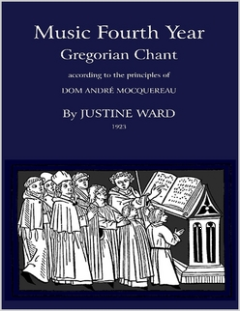 I’m very happy that my new copies of the classic editions of Ward singing tutorials have arrived. They are beautiful, and very exciting in so many ways – just to have them back in print is itself fabulous, and it goes without saying that they have stood the test of time.
A New Renaissance for Sacred Music
by Jeffrey Tucker, managing editor of Sacred Music
The market for recordings of polyphonic music is highly competitive, with ever more groups jumping into the sector with increasingly impressive performances. A CD I picked up recently is of the British singing group Stile Antico. The CD is called Song of Songs (Harmonia Mundi, 2009). It presents musical settings of text from the Song of Solomon, by some of the greatest composers of the 16th century, including Palestrina, Gombert, Lassus, Clemens non Papa, and Victoria. It seems that composers tended to reserve their most luxurious art for these particular passages of scripture that famously discuss love in such vivid terms.
But what is particularly striking is how this group features the distinctive quality of the music in the management of the ensemble itself. Unlike modern music, there is no “master/slave” relationship in the score, which is to say that there is no easy division between the melody and the accompaniment parts. Each voice plays a critical role in contributing to the overall effect. As a singer, one knows this when performing this music. The effect is strangely empowering.
Stilo Antico takes paradigm of what we might call radical equality and steps it up even further: the group has no director waving hands or even keeping a beat. Even for entrances, cutoffs, and tempo changes, anyone watching them sing detects not a single dominant person in charge. The singers come to understand each other and achieve what resembles perfect coordination. Now, someone in the know recognizes that there is an underlying pulse in operation that keeps everyone singing together, a pulse you feel but do not hear. And yet the audible effects sound completely seamless across time and space, like a variety of shapes of clouds in the sky moving from place to place.
Yes, it is all quite mystical and enchanting. I’ve never known anyone who isn’t dazzled by this type of music, performed with this level of perfection. If a person has never heard of this type of music before, the result is astonishment. Of course, this music is performed and marketed as what we might call art music. However, Catholics know that it is more than that. It is liturgical music, a music that elaborates on the text of the Roman Rite. It is the music of the faith. It is the music specifically mentioned by the Second Vatican Council as a worth extension of Gregorian chant, especially suitable for liturgy.
It is for this reason that a vast number of professionals and non-professionals have started groups for singing this music in its proper context: in Church, at Mass. The point is not to record it and sell it. The point is to provide a dramatic enhancement of the liturgical experience for both the people attending services and also for the transcendent purpose of glorifying God. No, these groups will never sound as perfect as a CD by Stile Antico, and that is fine. There is no something oddly artificial about a recording in any case, the way the listener can infinitely repeat what came before. In real time, every note passes through time to become part of our own history as soon as it happens; in liturgical time, every note passes into eternity as a gift with Divine purpose.
Is it any wonder that people are ever more aspiring to sing polyphonic music of this type, and in their own houses of worship? And let there be no doubt that this is happening. I’m preparing right now to attend the Sacred Music Colloquium XX, sponsored by the Church Music Association of America. This is a training program in chant and polyphonic music. This year it is being held at Duquesne University in Pittsburgh. It isn’t only about classroom work; the music is sung also in authentic liturgical settings. The purpose is not only art; it is also worship at morning prayer, vespers, and Mass.
I’ve been attending for many years but the level of participation and the intensity of interest has never before been like this. The first year I attend, there were 30 people. This year, the CMAA had to cut off registration at 250, simply because the program structure and the facilities could not handle any more than that. There is no way to know how many people might have come had the registrations not been closed long before the official deadline.
The people who are attending include full-time church music directors and some professional singers. But I think it is fair to say that most of the attendees are actually non-professionals who are seeking to improve their talents as an offering of praise to God, returning home to contribute to the parish liturgical programs.
Many are making large sacrifices to attend. They pay tuition and travel. They give up their vacation time from work. Since most Catholic musicians are not famously wealthy, they have had to raise money from friends and family. It is a pinch no matter how the bill is paid, and yet they do it. This year, some attendees are receiving small scholarships made possible by generous donors.
As for the CMAA itself, it is a very old organization, with roots in the 19th century, but it has no endowment. It has no large financial base. It raises money program to program. Most remarkably, it has no one who is paid a regular salary to work for the organization. There are no employees on its payroll. Its energy comes from volunteers and people with a range of talents who contribute in every way possible, providing services for free or absurdly discount rates. The workload grows and grows, simply because the demand is there for the CMAA’s services. Sometimes it seems nearly impossible that such an organization could exist in our times, and yet it does, and somehow not only gets by but thrives.
Does this structure for an organization make sense? Is it viable over the long term? Is it secure? Something tells me that that answer to all three questions is yes. Something that takes root this way from decentralized human energy has the greatest possible hope of having the largest effect on the world around us. No one is involve for any other reason than love of music and love of liturgy and the faith. As St. Augustine said: “Cantare amantis est.” Singing belongs to one who loves.
I could listen to CDs of amazing polyphonic music by professionals all day. But as great as these are, there is nothing to compare with being among 250 extremely passionate church musicians who are discovering, many for the first time, the secrets of this mysterious, glorious music, and learning how to weave it all into the most important part of our lives.